

Magician’s Assistants
A PSA on Being An HSP

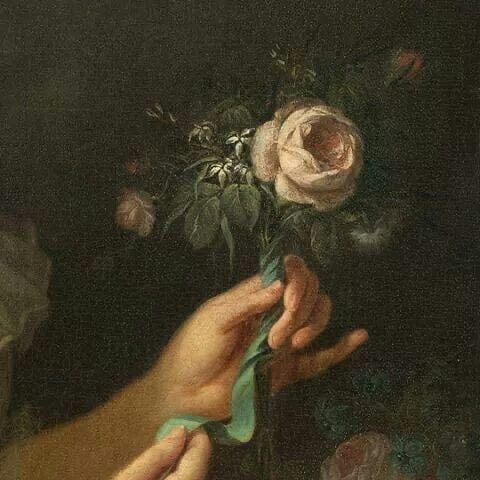
The romance of sweeping the last pine needles out the door on New Year’s Day. I watched them scatter across thick, damp mud and wet grass and into a particular kind of stillness that can only be felt on the first day of the year. A collective reset humming in the air, palpable as a train rumbling by somewhere in the distance.
Being an HSP almost sounds cool when it’s abbreviated—like having a kind of superpower, something similar to ESP. Highly Sensitive Person, on the other hand, written out in full, is a bit unfortunate, in my opinion. Maybe it’s because the word “sensitive” suggests fragility, emotional excess, someone with a penchant for the dramatic. And yet, for all its baggage, it’s actually the most accurate description for HSP. Sensitivity is the mechanism itself, describing a nervous system that processes more, registers more (and therefore feels more) at an ultra-rapid pace.
Let’s back it up a bit.
I have always been a sensitive person. Since early childhood, I have had a keen awareness of other people’s feelings and am deeply affected by the emotional landscape around me—whether good or bad. For a long time, I largely ignored this, chalking it up to my Cancer Sun sign or labeling myself as a bit shy or introverted.
Like many of us, with age I grew more comfortable and confident in who I was, yet I would still feel unexpectedly pummeled by my sensitivity. In my late twenties, I began to observe it more closely—a sad song or violent movie could completely alter my state and linger long after. I became aware of the social hangover I would feel after a party or event; sometimes even a one-on-one could do it. It wasn’t just a normal tiredness from putting out energy—it was a particularly heavy depletion that required a lot of silence and alone time to recalibrate.
Then I started recognizing how I could step into a room and register the mood of every person within seconds, sensing not just individuals but the collective atmosphere as a whole. At times, I would meet someone new and receive what felt like a full psychological profile download before knowing much about them at all. I had been doing this my entire life, but it took years to pay attention—and once I did, I wasn’t sure how to name it or what to do with it.

I don’t remember exactly how or when, but somehow I stumbled across the book The Highly Sensitive Person by Dr. Elaine N. Aron.
In the mid-1990s, Dr. Aron coined the term highly sensitive people to describe a temperamental trait called Sensory Processing Sensitivity (SPS). Through her evidence-based research, she discovered that HSPs have a more sensitive nervous system, meaning they process sensory and emotional information more deeply and more quickly. The research showed greater activation in brain regions linked to attention, empathy, and the integration of sensory input, as well as stronger responses in the insula and mirror neuron systems—two key networks involved in how we feel, interpret, and relate to others.
HSPs respond more strongly to all environments, but the difficult ones can result in severe fatigue and overstimulation because we tend to embody and experience other people’s emotions, energy, and moods as our own. For us, every social interaction is more vivid and sustained. Because of Dr. Aron’s findings, HSP—or SPS—is now recognized as a measurable, biologically rooted nervous-system trait.
I think it’s important to note that non-HSPs can also be incredibly empathetic, sympathetic, and sensitive people—it’s just that they are able to process other people’s emotions with a boundary. They can observe and filter what’s coming at them without physically feeling others’ emotional states as their own.
When an HSP is interacting with the world, they are picking up on every single detail like a detective. The most subtle cues (tone of voice, facial expressions, lighting, temperature—all of it) are absorbed subconsciously and filed away into a database to be analyzed and processed.
Let me tell you, it’s fucking exhausting to be an HSP, but once you know that you are one, it makes things a lot more manageable.
While I’m mostly accurate about what signals I’m picking up on—like if someone’s vibe feels off or a mood seems dark—where I go wrong is in taking it personally. I interpret someone’s bad mood as being directed at me, feeling that I am somehow to blame for it. Usually, it has nothing to do with me or isn’t that serious anyway—the person is simply having a bad day or feeling tired. I have to actively work to separate myself from their emotions, reminding myself that humans are constantly moving across a spectrum of feelings and that it isn’t my job to solve or manage them.
As an HSP, being a parent comes with a whole new set of challenges because there actually is a real responsibility in supporting someone emotionally. When my daughter was an infant, I could navigate her emotions with a lot of patience and presence because it was fairly straightforward—hungry, tired, wants comfort, etc. The toddler stage, however, is a wild ride of emotions and hormones that make little sense much of the time.
When she is having a tantrum, I feel that vast, erratic cocktail of emotions bubbling up as my own and have to work overtime to hold space for her—allowing her to move through it without desperately trying to fix it or getting dragged along and pulled under with her. Most parents have experienced the guilt and conflict of a school drop-off that goes badly. Now imagine being an HSP in that scenario—no bueno.
Over time, I’ve learned that managing my sensitivity isn’t about shutting down—it’s about creating clear boundaries so I can stay present without absorbing everything.
Missy Toy Ozeas, who speaks openly about being an HSP, introduced me to the idea of an energetic shield during emotionally charged moments. She would envision a beautiful rose between herself and her child—remaining fully available while protecting her own calm energy. It’s a tool I now regularly use during my daughter’s big emotional waves.
Beyond interpersonal boundaries, I’ve learned how essential it is to regulate my overall stimulation. I’m selective about what I watch and listen to, who I spend time with, and how much noise and clutter I allow into my environment. I avoid violent or overstimulating shows at night, no longer follow news accounts on social media, and keep my home intentionally clean and quiet. Nature and aesthetic beauty matter deeply to me—they allow me to choose my stimulation rather than be at the mercy of it.
I also rely on physical and emotional integration. Movement helps release excess energy, and showering at night has become a ritual for washing off the day’s emotional residue. When I feel charged by someone else’s emotions, I slow my thoughts and consciously separate what belongs to me from what doesn’t. Alexis Smart’s flower remedy for empaths, Páthos, is one I return to often for support.
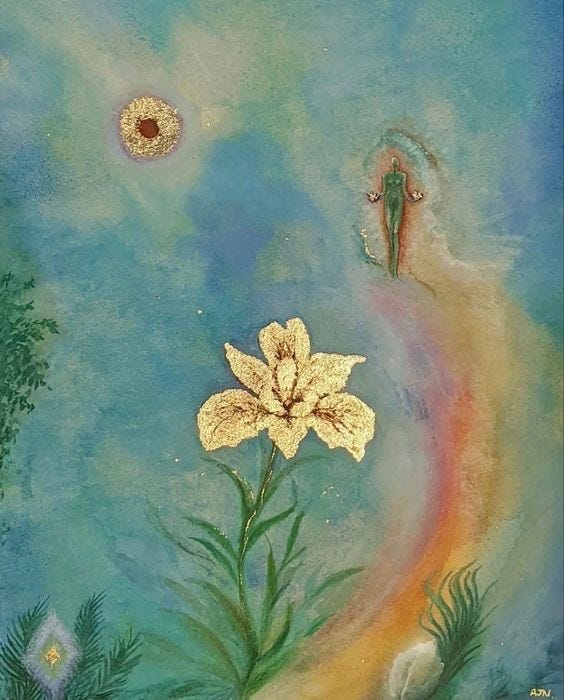
I’m not saying you have to live life in a bubble in order to cope. I’m hardly doing all of these practices at once, but rather selecting them as needed. You have to remember that positive, joyful experiences and interactions are felt more deeply for us too, which is a plus side of having the trait. We really love a good time and can relish the moment all the way! If we are near someone inspiring to us, we jump right on that rainbow with them and take a joy ride.
So that’s my PSA on being an HSP. Maybe you are one, or know one, or love one. Try not to count it as weakness or useless susceptibility. Maybe it is a superpower, if we can learn to harness it. If we can see ourselves as magician’s assistants privy to secrets: the ones with an eye for the sleight of hand, the ones who can see just a little further beyond the illusion.
So well written, as always, and an interesting piece!
So damn good